Part of: Construction Mortgages in Ontario
Financing, tax and rebates
The $130,000 HST Rebate Deadline for Custom Homes in Ontario
If you are building your own home on your own land, Ontario’s enhanced HST relief only applies if construction begins between April 1, 2026 and March 31, 2027. Getting from an idea to a hole in the ground takes months, so the real deadline to start planning is now.
What the CRA and Ontario actually say, who qualifies, how the $130,000 adds up, what “construction begins” probably means, and how people lose it. I am a builder, not an accountant, so take this to yours before you count on a dollar.
Short answer
The dates, in one place
The relief comes in two pieces with different names, and the rules differ depending on whether you build on your own land or buy from a builder.
Building on your own land? The owner-built home HST rebate guide walks through the federal side: who qualifies, which form you file and the deadline.
| Rule | You build on your own land (owner-built) | You buy a new home from a builder |
|---|---|---|
| The key date | Construction must begin on or after April 1, 2026 and on or before March 31, 2027 | Agreement of purchase and sale signed April 1, 2026 to March 31, 2027 |
| Finish by | Substantially completed before 2030 | Construction begins by Dec. 31, 2028; substantially completed by Dec. 31, 2031 |
| Value limit | Fair market value at substantial completion under $1,850,000 | Price under $1,850,000 |
| Forms | GST191 and RC7191-ON, which you file | GST190 and RC7190-ON, or the builder credits it |
This page is about the left column: you own the lot and hire a builder to put a house on it.
Eligibility
Who qualifies when you build on your own land
The CRA says the Ontario Enhanced New Housing Rebate applies where an individual builds a house, or “engages another person to construct” it. Hiring a builder to put a house on your lot counts.
- It has to be a home. The house must be built as the primary place of residence for you or a relation, and that intent has to be there from the start. The CRA says recreational cottages and investment properties do not qualify.
- Value under $1.85 million. Measured as fair market value when the house is substantially complete, land included.
- Start inside the window. Construction begins between April 1, 2026 and March 31, 2027.
- Finish before 2030. Substantially complete generally means 90 percent or more done and fit to live in.
- File on time. For owner-built homes, the CRA guide says you file within two years after the earliest of first occupancy, a sale, or substantial completion.
The basics of how the regular new housing rebate works for a custom build are in my older guide, the new home HST rebate for custom builds. This page is about the enhanced relief and its dates.
The numbers
How the $130,000 adds up
HST in Ontario is 13 percent: an 8 percent provincial part and a 5 percent federal part. The relief covers both, through two programs.
| Piece | What it covers | Maximum |
|---|---|---|
| Ontario Enhanced New Housing Rebate (with the regular Ontario new housing rebate), run by the CRA | The 8 percent provincial part of the HST you paid | $80,000 |
| Ontario New Home Affordability Payment, run by Ontario | The 5 percent federal part, less any federal new housing or first-time buyer rebate you get | $50,000 |
Both scale with the home’s value the same way: full relief up to $1 million, a flat maximum from $1 million to $1.5 million, partial relief from $1.5 million to $1.85 million, and nothing at $1.85 million or more.
Ontario says there is no separate application for the $50,000 piece. You have to qualify for and receive the enhanced rebate first, and it flows through the CRA claim.
The catch for owner-built homes: you only get back HST you actually paid. You pay HST on the builder’s contract and on materials you buy. A lot bought from a private seller often had no HST on it at all. Roughly speaking, to reach the full $130,000 you need about $1 million of spending that carried HST. A smaller house gets back a smaller number. Ask your accountant to run your own figures. Before that meeting, run the free 2-minute HST rebate check so you walk in with the right questions.
The fine print
What “construction begins” likely means
Here is the honest answer: the CRA’s page for this rebate does not define it.
For a different rebate, the one for purpose-built rental housing, the CRA said in 2024 that construction is considered to begin when excavation work begins. That is the closest official reading I have found. It does not automatically apply here, but I would not bet $130,000 on anything less. CRA has its own test for that, and what CRA counts as construction beginning is spelled out on OntarioHSTRebates.ca, a site that covers nothing but Ontario HST rebates.
- Probably not a start: a permit in a drawer, a signed contract, a survey, or a lot cleared of trees.
- Probably a start: an excavator digging the foundation for the house.
Keep proof. Dated photos of the dig, the excavation invoice, and the footing inspection record. And ask your accountant to put their opinion in writing before you plan around it.
Why now
Why the real deadline is closer than March 31, 2027
You cannot dig until you have a building permit, and you cannot get a permit until a long list of things is done. The code gives the township 10 business days to decide on a complete permit application for a house. That clock does not start until the application is complete, and getting it complete is where the months go.
Here is what usually has to happen first, using Tiny’s own permit checklist as the example:
- House design and construction drawings
- Heat loss, ventilation and duct design, plus the energy efficiency design summary
- Septic design and approval from the sewage authority
- A survey by an Ontario Land Surveyor and a lot grading plan
- An entrance permit for the driveway, which in Tiny has to come before the building permit
- Conservation authority approval, if the lot is regulated
- Your builder’s contract, schedule and construction mortgage
Winter makes it harder. Tiny warns that an entrance permit applied for in winter may not be reviewed until spring. Some of those steps can run side by side, but none of them is quick, and you need a builder whose crew is free to dig when the permit lands. For how the steps fit together, see the custom home building process and building permits in Ontario.
The good news for a winter start: ICF foundations can go in during cold weather with the right precautions. I explain how in winter construction with ICF. If you already have drawings and a lot that checks out, a start before the end of March is realistic. If you are starting from a blank page this fall, it is tight, and I will tell you so on the first call.
Want to start before March 31, 2027?
Send me your plans, or book a call if you only have a lot. I will tell you what still has to happen before we can dig, and whether the window is realistic for your project.
Avoid this
How people lose the rebate
- It is really a cottage. A second home or a rental does not qualify. The intent to live there has to be there from day one.
- The value runs over. At $1.85 million or more, finished value with land, there is no enhanced relief.
- Bad paperwork. The CRA wants original invoices kept for six years and does not accept estimates, quotes, statements or photocopies as proof. Cash deals with no HST on the invoice give you nothing to claim.
- Missing the filing window. File within the two-year limit.
- Using the wrong rules. The purchase-from-a-builder rules turn on the agreement date. Owner-built rules turn on when construction begins.
- Starting late. A March 31 start that slips to April because the permit was not ready.
How the rebate interacts with your draws and cash flow is covered in construction financing and HST. A clear contract helps too; see 12 clauses for a custom home contract. For the full money side of the build, go back to construction mortgages in Ontario.
Free book
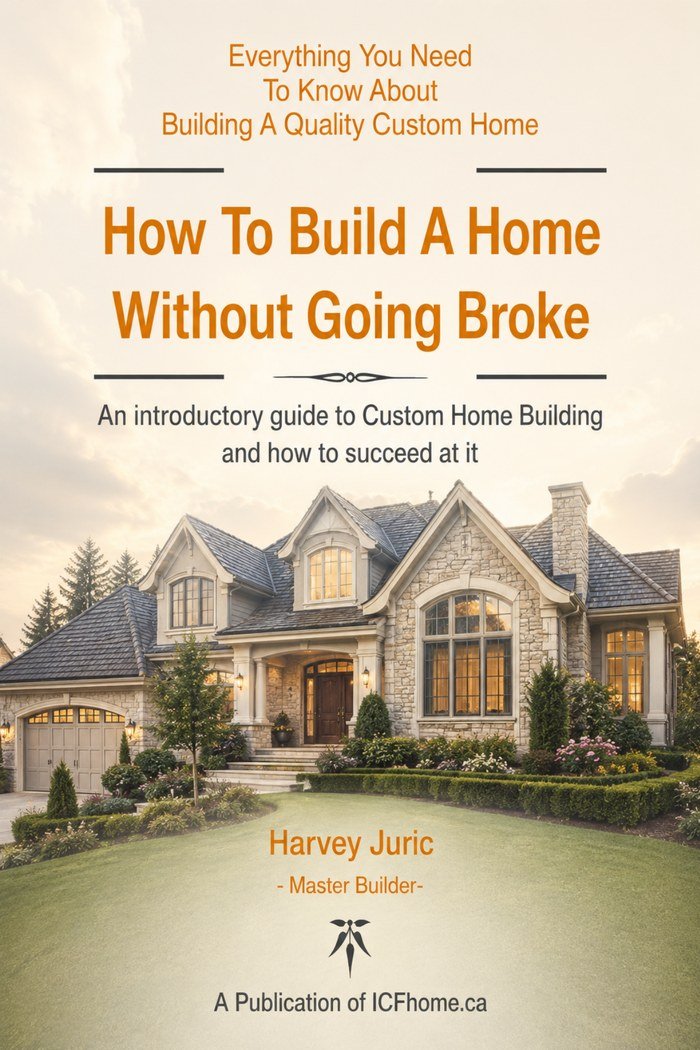
How to Build a Home Without Going Broke
Not ready to call anyone yet? Fair enough. Read the book first: the costly mistakes I have watched people make over 45 years of building, and how to avoid every one of them. Free PDF, straight to your inbox.
Questions people ask
FAQ
Do owner-built homes qualify for the Ontario enhanced HST rebate?
How is the $130,000 made up?
What counts as construction beginning?
Does a cottage qualify?
When do I apply?
Is March 2027 enough time if I start planning now?
Keep reading
Related guides
Keep going
More in this topic: Financing, Tax and Rebates
See all 12 steps of building a custom home, with every guide on the site | Straight answers: hours, payments, warranty, where we build
Pick the path that matches where you are
Aiming to break ground before March 31, 2027? The sooner I see your plans or your lot, the sooner I can tell you if it is realistic. Or call 705-533-1633, Monday to Friday 8 to 5 (weekends by appointment).