Part of: How to Choose a Custom Home Builder
Builders and contracts
Being Your Own General Contractor in Ontario
Yes, you can build your own house in Ontario without a builder’s licence, as long as it is for you and not to sell. Whether you save money depends on how much time you have, how many mistakes you avoid and how much the bank and the trades trust you.
One more job for the owner-builder: filing your own HST rebate. Here is how the owner-built home HST rebate works, and why you keep every invoice from day one.
I will be fair about this. Some people do it well. Here is what you sign up for, what you give up, where the savings really go, and a middle ground where we build the hard parts and you finish the rest.
Short answer
Yes, it is legal. Here is what you sign up for.
Ontario’s Home Construction Regulatory Authority (HCRA) licenses new home builders. Its guidance says a person building a home for their own use, on land they own, may not need a builder’s licence, as long as they do not sell the home after construction. That is an owner-builder.
The HCRA is just as clear about the other side. As an owner-builder, you take on the builder’s role. That means you manage the whole project, you are responsible for workplace safety and insurance on your site, you get the permits, and you contract directly with the trades and suppliers.
Some building departments make you sign an owner-built acknowledgement with your permit. Typical forms say you are taking on the builder’s role, you are not building to sell, and the home will not have statutory warranty coverage. Ask your township if they use one.
What you give up
Tarion, HCRA and the warranty you give up
When a licensed builder builds your house, the home is enrolled in Ontario’s new home warranty program, run by Tarion, with statutory coverage after you move in. I explain what that covers in the Tarion warranty guide.
An owner-built home is not eligible for that warranty. The HCRA says so plainly. One township’s owner-built form goes further: no warranty claim can be made for the home by the owner or by any later buyer. If the basement leaks in year three, the person you call is you.
Selling matters too. The licence exemption depends on not building to sell. Build a house, sell it soon after, and you can find yourself treated as a builder who needed a licence, and in Ontario it is illegal to build or sell a new home without one. If there is any chance you will sell, talk to the HCRA before you start.
When we build, you get Tarion coverage plus our own 7-year materials and workmanship warranty. That is not a sales line. It is what you are giving up when you go it alone, and it is worth pricing honestly.
Money
How the bank treats owner-builders on draws
Almost every custom home is paid for with a draw mortgage. The lender pays out in stages as work is finished, and inspections are required at each stage before the next draw is released. Down payments of 20 to 30 percent are commonly cited for construction mortgages. I walk through the details in construction mortgages in Ontario.
Lenders want comfort that the people building are licensed and have a track record. An owner-builder has to supply that comfort another way. Expect some lenders to say no, and the ones who say yes to want:
- A detailed budget with real quotes, not estimates
- A contingency, and proof you can fund it
- A schedule they believe
- More of your own money in the job before the first draw
The cash-flow squeeze is where owner-builders get hurt. Trades want paying when the work is done. The draw comes after the inspection. You float the gap. A builder floats it for you as part of the job.
On tax: owner-builders apply for the new housing rebate themselves on CRA form GST191. Ontario’s enhanced HST relief can apply to an owner-built primary residence where construction starts between April 1, 2026 and March 31, 2027. See our HST rebate guide and confirm with your accountant. The form is the GST191, and this GST191 worksheet walks through it line by line.
Running the site
Trades, scheduling and who calls the inspector
A custom house is a few dozen trades and suppliers who all need the job before them to be finished and done right. As the general contractor, keeping that line moving is your job.
You book every trade
Good trades are busy. They look after the builders who give them work every year first. A one-time customer usually waits.
You call the inspector
Building departments expect notice before each inspection stage; at least 24 hours is common. Inspectors check stages. They are not there to supervise your site.
You own the mistakes
If the framer builds to a wrong dimension because the plans were unclear, you pay to fix it. There is nobody between you and the problem.
A few things people miss. If you wire the house yourself, ESA rules say the person doing the work files the electrical notification before starting. Workplace safety on site is yours, because the HCRA says so. And when two trades blame each other for a problem, you are the one who decides who fixes it.
If you go ahead, use a written contract with every trade, with scope, price and payment terms, and know how the holdback works before the first invoice. See the construction lien holdback.
The real savings
Where the “savings” disappear
The pitch is simple: skip the builder’s margin and keep it. The margin is real. So are these:
- Your time. Running a site is a full-time job. If you still have a job, one of them suffers.
- Carrying costs. Every week the house runs late is another week of interest on the draws, and maybe rent where you live now.
- Pricing. Builders who buy every year often get better prices and terms than a one-time buyer.
- Rework. One wrong sequence, like drywall before an inspection, can wipe out a lot of margin.
- Gaps between quotes. Things nobody quoted because each trade assumed someone else had it.
- No warranty. Any defect after move-in is yours to fix.
I am not going to put a percentage on it, because it depends entirely on you. Some owner-builders come out ahead. Others pay more than a builder would have charged and take twice as long. Be honest about which one you are. For the bigger picture on budget surprises, read the 10 budget traps.
Middle ground
Middle ground: we build the hard parts, you do the finishes
There is a lot of room between “builder does everything” and “I do everything”. Two setups I like:
We build the ICF shell
- Foundation and ICF walls, the part that needs experience and a crew
- You take over for the interior
- Good for capable owners with time
We build the house, you finish
- We run the build start to finish
- You keep jobs like painting, trim or landscaping
- You save where your labour is worth the most
How the contract is set up decides who counts as the builder and whether the home is enrolled with Tarion. We sort that out with you, and with the HCRA if needed, before anything is signed. See ICF foundations and our project management and consultation services.
Our payment schedule is plain either way. On ICF foundation and wall work it is 10 percent at signing, 40 percent when materials are delivered, 40 percent before the pour, and the last 10 percent held back and released under the Construction Act holdback rules. Our minimum job is $20,000. For pricing approach, see cost-plus vs fixed price.
Price it both ways
Send your plans and I will price the full house and the shell-only option side by side. Then you can decide with real numbers. ICFpro.ca has the details on our ICF shell for owner-builders.
Still deciding who should build it? Start with how to choose a custom home builder.
Free book
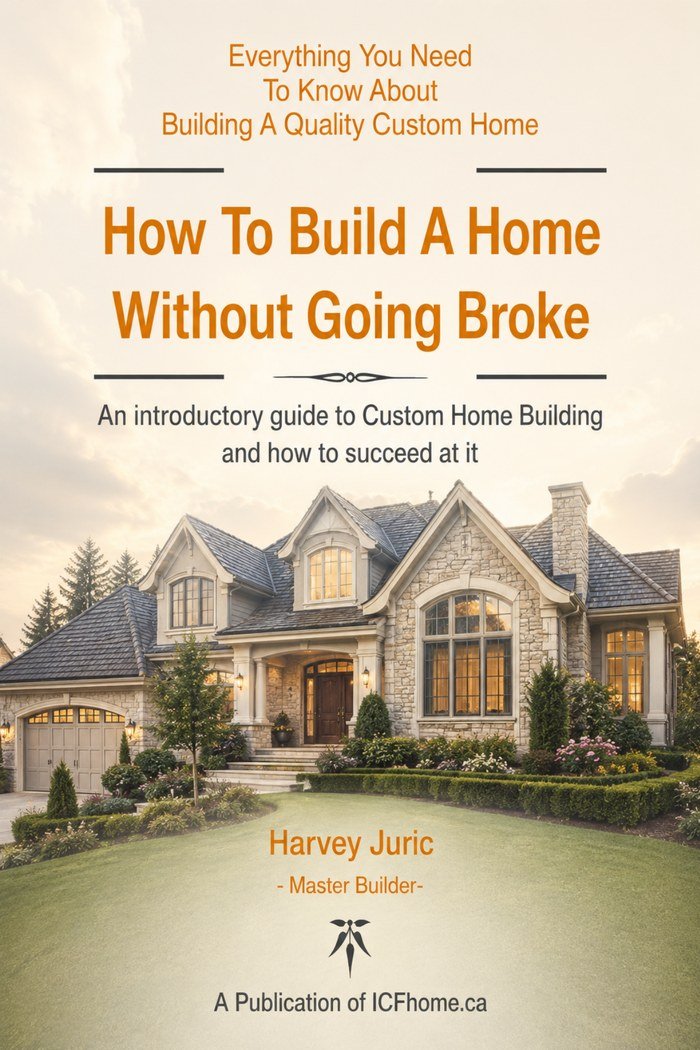
How to Build a Home Without Going Broke
Not ready to call anyone yet? Fair enough. Read the book first: the costly mistakes I have watched people make over 45 years of building, and how to avoid every one of them. Free PDF, straight to your inbox.
Questions people ask
FAQ
Can I be my own general contractor in Ontario?
Do owner-built homes get a Tarion warranty?
Will the bank give me a construction mortgage as an owner-builder?
Can I sell a house I built myself?
How much can I save being my own general contractor?
Can I hire you for just the ICF shell?
Keep reading
Related guides
Keep going
More in this topic: Choosing a Builder and Contracts
See all 12 steps of building a custom home, with every guide on the site | Straight answers: hours, payments, warranty, where we build
Pick the path that matches where you are
Weighing owner-build against hiring a builder? Send me your plans and I will price the whole house, or just the ICF shell, so you can compare. Or call 705-533-1633, Monday to Friday 8 to 5 (weekends by appointment).